徐宇华(Melody)博士现任美国亚利桑那州立大学社区资源与发展学院(旗下海亚国际学院-HAIC)助理教授,并担任HAIC旅游发展与管理本科项目负责人。她热衷于推动教育与研究的创新,主要关注教育技术的应用、目的地管理的提升以及社区韧性的强化。徐博士致力于培养新一代旅游业领袖,帮助他们具备应对复杂全球挑战所需的技能与远见。
Dr. Yu-Hua (Melody) Xu is an Assistant Teaching Professor in the School of Community Resources and Development at Arizona State University. With a passion for fostering innovation in education and research, she focuses on leveraging education technology, advancing destination management, and strengthening community resilience. Dr. Xu is committed to empowering the next generation of tourism leaders by equipping them with the skills and vision to navigate complex global challenges.
谷歌学术网址 Google Scholar link:
https://scholar.google.com/citations?user=WCoFSlIAAAAJ&hl=en&oi=ao
亚利桑那州立大学个人网页 ASU webpage:
https://search.asu.edu/profile/3724027
部分发表成果 Selective Publications:
(* 号表示学生;通讯作者以下划线标注)
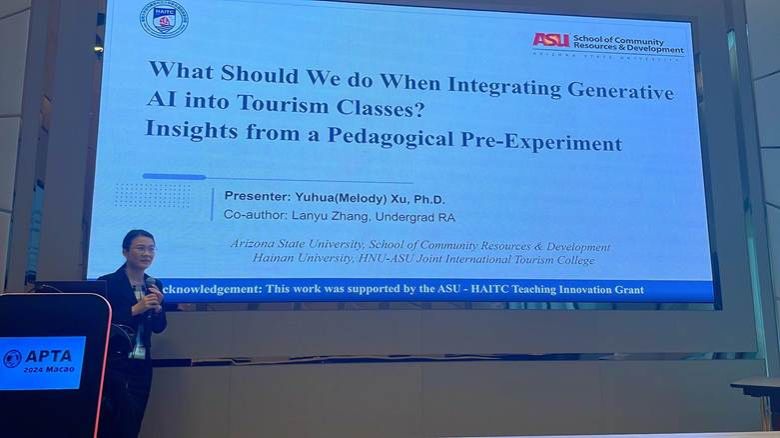
1. Xu, Y. H. (2025) Integrating Generative AI into Tourism Classes? Insights from a Pedagogical Pre-Experiment. Travel and Tourism Research Association (TTRA) conference proceedings. https://hdl.handle.net/20.500.14394/57306
摘要:生成式人工智能(GenAI)融入高等教育,标志着教学方法正朝着创新方向发生关键性转变。随着越来越多学生将GenAI用于学术目的,教育工作者亟需主动调整教学方法,以跟上人工智能技术的发展步伐。本研究采用自然教学法,在高校旅游课程中尝试整合GenAI技术,并考察了学生的使用习惯、对GenAI的认知及其学习成果。初步结果显示,性别、专业、课程性质以及学生过往经验均会影响GenAI在教育中的应用效果。本研究为高校教育者及旅游专业教师提出了具体建议。
ABSTRACT: The integration of generative artificial intelligence (GenAI) into higher education signals a pivotal shift towards innovative teaching and learning methodologies. With an increasing number of students using GenAI for academic purposes, faculties urgently need to proactively adapt pedagogical methods to keep pace with the advancement of AI technologies. The study adopted a natural pedagogical approach, experimented integration of GenAI to college tourism courses and examined students’ using habits and perception of GenAI and their studying outcomes. The preliminary results showed that gender, major, the nature of courses, and students’ past experiences all matters when using GenAI for educational purposes. Specific suggestions were raised for college educators and tourism instructors.
2. Xu, Y.H., Pennington-Gray, L., Kim, J.W (2021). Spatial Effect of Crime on Peer to Peer lodging Performance.Journal of Travel Research, 61(4), 855-871. https://doi.org/10.1177/00472875211008255 (SSCI, Q1, IF:8.933)
摘要:安全是影响消费者参与点对点(P2P)经济的重要因素。本研究运用空间计量经济学模型,从三个空间层面——物业层面、社区层面和目的地层面,考察了犯罪活动对P2P住宿业绩(每间可用客房收益)的影响。研究发现,P2P住宿的业绩表现与犯罪密度呈负相关,且相关程度因犯罪类型与客房类型而异。犯罪活动会产生"空间溢出效应",对社区层面的影响最为显著,其次为目的地区域,最后是物业自身层面。本研究通过犯罪学理论与社会不确定性的概念,为理解旅游风险提供了新的视角。在实践层面,研究对社区型住宿业的治理具有启示意义。我们认为,犯罪对P2P住宿业绩的影响更大程度上取决于其周边社区及整体目的地的安全环境,而非单个商户的经营行为。
ABSTRACT: Safety is a major factor impacting consumers’ participation in peer-to-peer (P2P) economies. Using spatial econometric models, this study examined crime effects on the performance (RevPAR) of P2P lodgings at three spatial ranges: property, community, and destination level. The performance of P2P lodgings is negatively associated with crime densities, while the degree of the association varies by crime types and room types. Crime can “spill over” to the neighborhood and have the strongest impact at the community level, followed by the destination level and the property level. The study provides a way to understand tourism risks using criminology theories and the concept of social uncertainty. Empirically, the study provides implications to the governance of community-based lodging business. We suggest that the effect of crime on P2P lodging performance was more conditioned by the safety environment in its neighborhood and the whole destination, rather than individual business operations.
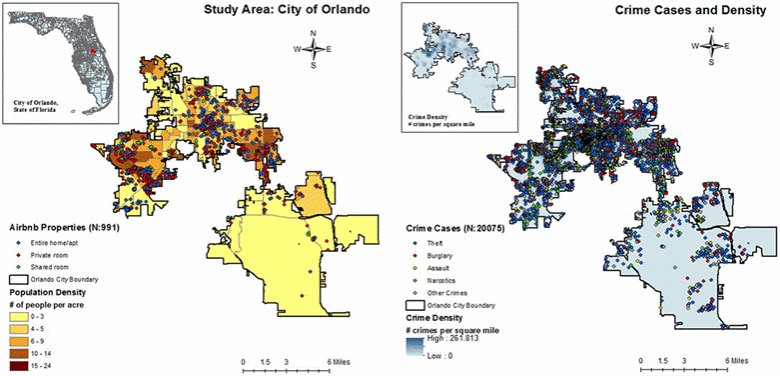
Figures.(A)Airbnb properties in the city of Orlando (left). (B) Crime incidents and crime density in the city of Orlando (right).
3. Xu, Y. H., Pennington-Gray, L., & Kim, J. (2019). The sharing economy: a geographically weighted regression approach to examine crime and the shared lodging sector. Journal of Travel Research, 58(7), 1193-1208. https://doi.org/10.1177/0047287518797197 (SSCI, Q1, IF:7.027)
摘要:共享经济通过提供高性价比的住宿方案,已在住宿业中占据显著市场份额,但也日益受到犯罪事件频发的困扰。本研究以佛罗里达州为案例,系统考察了Airbnb房源密度与犯罪率的全局关联,并深入探究了该关系在县级层面的空间异质性。结果显示,犯罪与住宿业态的关联性因房源类型而异,但与犯罪类型无关:仅有“合住房间”类型与财产犯罪、暴力犯罪均呈现稳定正相关,而“独立房间”和“整套房屋”则呈现负相关。通过地理加权回归分析发现,这种关联存在明显的局部空间变异,该现象可结合当地旅游发展程度与族群多样性进行解释。我们建议在共享住宿业的犯罪防治中,应对财产犯罪与暴力犯罪予以同等重视,并在制定应对策略时充分考虑地区差异因素。
ABSTRACT: The sharing economy has gained great market share within the lodging sector by offering cost-effective accommodation solutions. However, it is also troubled by increasing criminal incidents. This study examined the global relationship between the density of Airbnb and crimes in Florida, explored how the relationships vary at the county level. The results suggested that crime-lodging associations vary by listing types but not crime types. Only the Shared Room type consistently exhibited positive associations with both property and violent crimes, while Private Room and Entire Home exhibited negative associations. Local variations were identified by geographically weighted regression, which could be explained by the local tourism development and ethnic diversity degree. We suggested equal efforts in preventing both property and violent crimes in home sharing business. Also regional differences need to be considered when responding to shared lodging crimes.
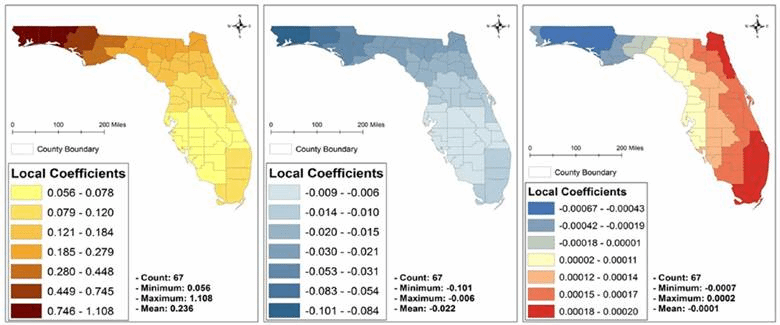
Independent variables from left to right: Share Room, Private Room, Entire Home; dependent variable: Property crime
4. Wu, G. M.*, Chen, S. R.*, & Xu, Y. H. (2023). Generativity and inheritance: understanding Generation Z’s intention to participate in cultural heritage tourism. Journal of Heritage Tourism, 1-18. (ESCI, Q2, IF:3.0) https://doi.org/10.1080/1743873X.2023.2178927
摘要:文化遗产旅游日益受到大众欢迎,既丰富了旅游者的文化体验,也满足了其代际传承需求。然而,学术界对年轻群体在文化遗产旅游中代际需求的研究关注有限。为此,本研究聚焦大学生的代际传承动机,基于拓展的计划行为理论模型,探究影响其参与文化遗产旅游意向的因素。通过对233名大学生的问卷数据进行多元线性回归分析,结果表明:大学生的代际传承动机、对文化遗产旅游的态度、主观规范及感知行为控制均对其参与意向产生正向影响。年轻人代际传承动机与其文化遗产旅游意愿之间的正向关联,为现有旅游行为研究提供了新的理论视角。同时,本研究为旅游管理者及营销者吸引年轻一代参与文化遗产旅游提供了实践启示。
ABSTRACT:Cultural heritage tourism (CHT) has become increasingly popular among the general public, enriching tourists’ cultural experiences and realizing their generative needs. However, limited academic attention has been paid to the research on young people’s generative needs in CHT. Therefore, this study investigated college students’ generativity and developed an extended TPB model to explore the factors influencing their travel intention in CHT. Multiple linear regression analysis was performed on the questionnaire data of 233 college students. The results indicated that college students’ generativity, attitude towards CHT, subjective norm, and perceived behavioral control all positively affected their intention to participate in CHT. The positive correlation between young people’s generativity and their travel intention in CHT has contributed to the existing literature on tourist behavior. Meanwhile, some practical implications were provided for tourism managers and marketers to attract the young generation to engage in CHT.
5. Wu, G.*, Guan, S.*, Xu, Y. H., Chu, C.*, & Zhu, Z.* (2023). The Closer, the Better? Impact of Tourists’ Psychological Distance on Their Travel Intention in the Post-Pandemic Era. Journal of China Tourism Research, 1-24. https://doi.org/10.1080/19388160.2023.2232537 (ESCI, Q3, IF:1.3)
摘要: 2020年以来,新冠疫情对全球旅游业造成了严重影响,极大削弱了游客的旅行意愿。为了解后疫情时代游客的心理弹性,本研究借助问卷调查并运用结构方程模型,深入探讨了在后疫情时代下中国游客的心理距离如何影响其旅行意愿。研究结果表明,游客的社会距离和时间距离与其旅行意愿呈负相关,但没有足够的证据证明游客的空间距离与其旅行意愿之间存在相关性。此外,感知安全在游客的社会距离、时间距离与旅行意愿之间具有显著的中介效应。研究结果为帮助了解游客心理距离与旅行意愿之间关系的做出了贡献。同时,为旅游行业提供了一些实际策略,以减少人们的旅行焦虑并鼓励他们积极地参与到旅游活动之中。
ABSTRACT: Since 2020, COVID-19 pandemic has exerted a serious influence on global tourism and dampened tourists’ travel intention. To understand the traveling public’s psychological resilience in post-COVID-19 travel, this study adopted survey study and employed structural equation modeling (SEM) to explore how tourists’ psychological distance affects travel intention in the context of the COVID-19 pandemic. The results indicated that tourists’ social distance and temporal distance were negatively correlated with their travel intention, whereas there was insufficient evidence to prove that tourists’ spatial distance was related to their travel intention. More interestingly, perceived safety significantly mediated the relationship between social distance, temporal distance, and tourist travel intention. These findings contributed to the empirical research on the correlation between tourists’ psychological distance and their travel intention. Meanwhile, practical strategies were provided for the tourism industry in reducing people’s travel anxiety and encouraging their participation in tourist activities in the post-pandemic era.
学术服务 Service
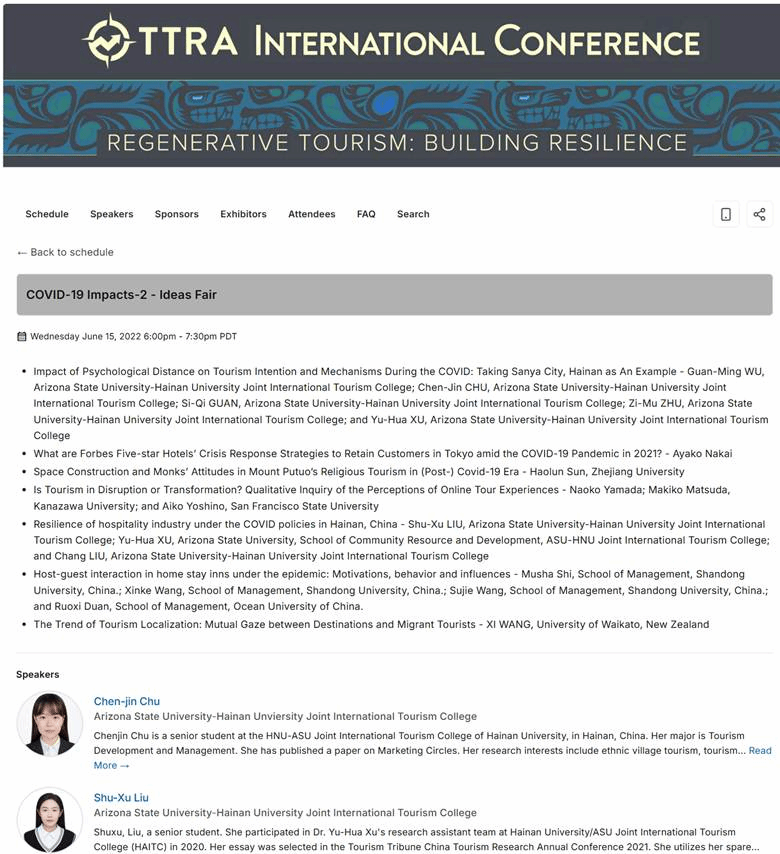
徐宇华博士积极参与旅游与酒店管理领域的编审工作。她目前担任《Tourism Management Perspectives》(SSCI-Q1索引)和《Tourism and Hospitality Research》(ESCI-Q2索引)两本期刊的编委会成员。同时,她长期为《Tourism Management》《Annals of Tourism Research》《International Journal of Contemporary Hospitality Management》等权威期刊担任审稿人,并为TTRA(旅行与旅游研究协会)、APTA(亚太旅游协会)等国际重要学术会议提供论文评审服务。
Dr. Yu-Hua Xu contributes to editorial and reviewing activities in tourism and hospitality management. She serves on the editorial boards of Tourism Management Perspectives (SSCI-Q1) and Tourism and Hospitality Research (ESCI-Q2). She regularly reviews for leading journals such as Tourism Management, Annals of Tourism Research, and International Journal of Contemporary Hospitality Management, and for major international conferences including Travel and Tourism Research Association(TTRA) and Asia Pacific Tourism Association(APTA).
