Yunseon Choe博士是社区资源与发展学院及海南大学亚利桑那州立大学国际学院的副教授。在旅游业增长给自然带来日益加剧压力的背景下,她的研究主要关注:在公园和旅游目的地语境下,人与公园在实现可持续旅游发展中的作用,以及如何通过先进方法和利益相关者参与来指导公园及旅游管理的可持续实践。
她的研究主题聚焦于人、公园与旅游三者交汇处的可持续性,并在方法论上强调将美国的研究模式应用于亚洲多样化的环境。通过在国内外情境中测试和应用新的定性及定量研究方法,她的工作立足于多股研究脉络的交叉点,同时利用最新技术进展来制定更优的可持续管理策略并提升游客体验。沿此路径,她致力于探索自然界在塑造人类行为方面的角色,以及人们与之管理和保护相关的价值观与行动。
Yunseon Choe is an associate professor in the School of Community Resources and Development with HNU-ASU International College, Hainan University. In the context of the growing pressure placed on nature by increased tourism, her main research considers the role of people and parks in attaining sustainable tourism development in the context of parks and tourism destinations and how the sustainability of park and tourism management may be informed through advanced methodologies and stakeholder engagement.
Her research theme is sustainability within the nexus of people, parks, and tourism, with a methodological emphasis on transferring U.S. models to various settings in Asia. Her work, achieved through testing and applying new research methods in both qualitative and quantitative approaches in domestic and international settings, sits at the intersection of multiple research strands, while utilizing recent technological advances to establish better management strategies for sustainability and enhancing visitor experiences. Along these lines, she seeks to understand the role that the natural world plays in defining human behavior as well as people’s values and actions associated with its management and protection.
谷歌学术链接Google Scholar link:
https://scholar.google.com/citations?hl=en&user=imrYFx8AAAAJ
部分发表成果Selective Publications:
Choe, Y., Lee, C. K., Choi, J., Kim, M., & Sim, K. W. (2023). Identifying tourist spatial and temporal patterns using GPS and sequence alignment method. Journal of Travel Research, 62(6), 1181-1201. https://doi.org/10.1177/004728752211276
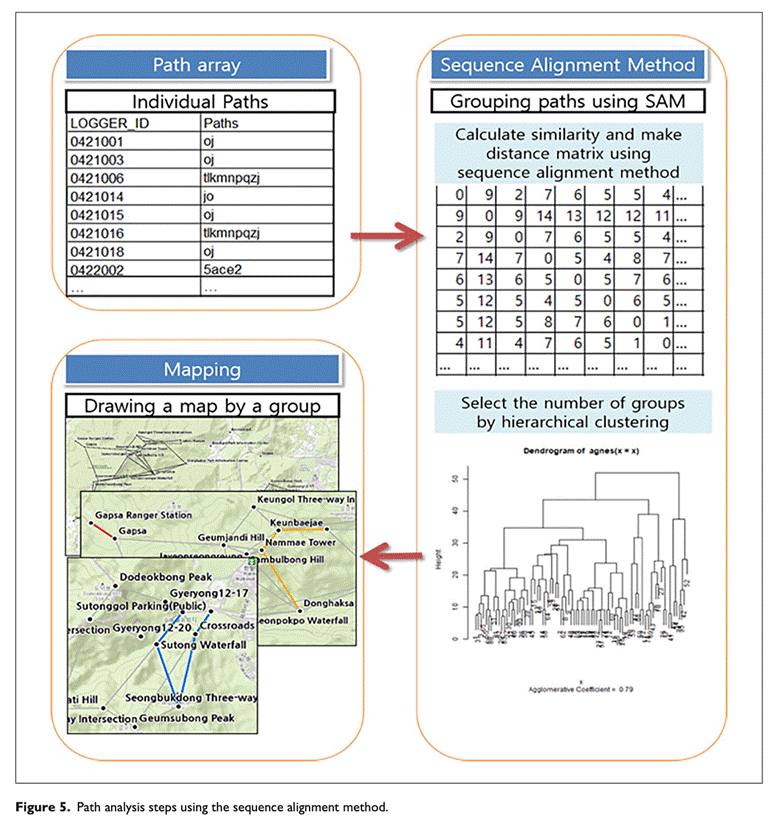
摘要:本研究基于时间地理学中的时空路径概念,结合全球定位系统技术与问卷调查,并运用序列比对方法,识别了国家公园游客的时空行为模式。数据采集自韩国鸡龙山国家公园的344个GPS轨迹样本及配套问卷。研究采用基于移动定位数据的复杂随机分层抽样方法,以代表全国性样本。序列比对分析结果显示,从341条有效序列中提取出的83条独特路径可归纳为三类游客群体。基于平均旅行距离、平均游览时长和平均旅行速度的路径分析显示出显著的组间差异。本研究的主要理论贡献在于,通过结合序列比对方法与GPS分析对时间地理学理论进行方法学上的改进,从而拓展了该理论的应用范围。
Abstract: This study identified the spatial and temporal patterns of national park visitors by combining global positioning system (GPS) technologies and surveys using the sequence alignment method (SAM) based on the concept of space–time path of time geography. Data were collected from a sample of 344 GPS tracks and questionnaires obtained from Gyeryongsan National Park in South Korea. A complex random stratified sampling method was employed to represent a national sample based on mobile positioning data. The result of the SAM analysis revealed that the derived visitor typologies constituted three groups from 83 unique paths extracted from 341 sequences. Significant intergroup differences were found for the paths based on average travel distance, average visit duration, and average travel speed. The main theoretical contribution of this study is in expanding the application of the theory by providing methodological improvements using SAM and GPS analysis of the theoretical basis of time geography.
Yoo, J., Choe, Y., & Lee, G. (2022). Exploring pilgrimage value by ZMET: The mind of Christian pilgrims. Annals of Tourism Research, 96, 103466.https://doi.org/10.1016/j.annals.2022.103466
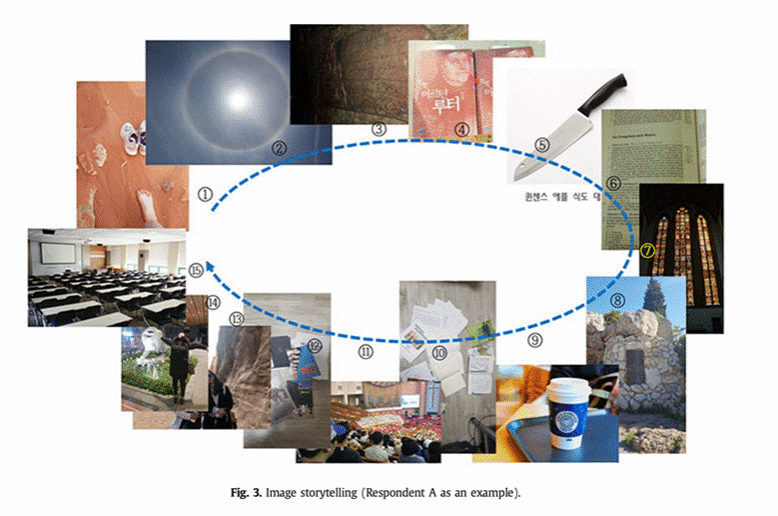
摘要:现有关于朝圣的研究主要聚焦于朝圣者动机中的理性认知。本研究采用扎尔特曼隐喻诱引技术(一种强大的照片启发技术),深入探究关于朝圣价值的有意识与无意识思想,旨在揭示访问基督教圣地的韩国新教实践者在朝圣经历中采用的隐喻性或非字面性表达。研究结果揭示了朝圣价值的四个核心主题:灵性体验、圣经关联、情感共融(Koinonia)以及新奇感知。本研究为拓展方法论视野提供了重要启示,即运用ZMET技术,通过在朝圣语境中结合详尽叙事与富有意义的隐喻及图片,从而有效激发潜藏在朝圣者内心深处的朝圣价值认知。
Abstract: Existing studies on pilgrimage have focused on rational perceptions in the motivation of pilgrims. Adopting Zaltman Metaphor Elicitation Technique (ZMET), a powerful photo-elicitation technique, this study delves deeper into both conscious and unconscious thoughts on pilgrimage values to uncover the metaphoric or non-literal expression of people with pilgrimage experiences among Korean practicing Protestants visiting Christian holy lands. Results of this study manifest four themes in pilgrimage values: spirituality, Biblical experience, emotional unity (koinonia), and novelty. The study presents meaningful implications for broadening the methodological horizons using ZMET to elicit pilgrimage values that lay dormant in the minds of pilgrims by detailed storytelling and meaningful metaphors and pictures in the pilgrimage context.
Choe, Y., Wang, J., & Song, H. (2021). The impact of the Middle East Respiratory Syndrome coronavirus on inbound tourism in South Korea toward sustainable tourism. Journal of Sustainable Tourism, 29(7), 1117-1133. https://doi.org/10.1080/09669582.2020.1797057
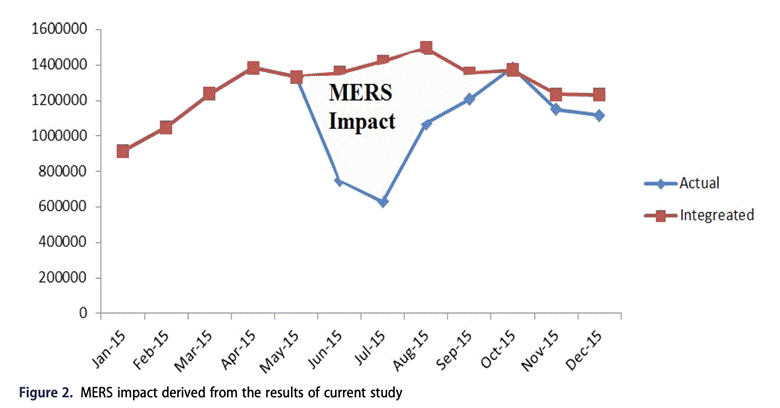
摘要:尽管韩国于2015年12月宣布中东呼吸综合征冠状病毒疫情结束,该疫情实际持续了两个月,但其导致的国内经济与旅游业萧条并未立即恢复。因此,探究该疾病造成的实际影响程度及损害持续时间显得尤为重要。本研究采用定量时间序列模型,分析了MERS疫情对韩国入境旅游的影响,并估算了2015年疫情对旅游市场的具体冲击。数据来源于韩国旅游组织提供的2009年1月至2015年12月的月度国际游客到访统计数据。结果显示,该传染病对赴韩入境游客数量产生了统计上显著的负面影响。在MERS疫情影响期间(2015年6月至9月),总效应估计为游客减少1,968,765人次,旅游收入损失达31亿美元。本研究不仅有助于更准确地评估疫情对入境旅游客流量的影响,也为政策制定者建立有效应对机制、在此类危机中确保游客的安全信心提供了决策支持。
Abstract: Despite the declaration of the end of the Middle East Respiratory Syndrome coronavirus (MERS) outbreak in December 2015 in South Korea that the epidemic lasted for 2 months, the depressed domestic economy and tourism sector did not immediately restore. Thus, it is important to explore how much of an impact the disease had and how long the damage lasted. Using quantitative time-series models, the present study explored the influence of MERS on inbound tourism in South Korea and estimates the concrete impact of MERS on the market in 2015. Monthly international tourist arrival data were provided by the Korea Tourism Organization from January 2009 to December 2015. The results showed that the contagious disease was statistically and negatively significant for inbound tourists visiting South Korea. During the time of MERS, from June 2015 to September 2015, the total effect was estimated to be −1,968,765 tourists with a loss of 3.1 billion USD in receipts. This study can not only better estimate the impact on tourism number of inbound tourist arrivals, but also supports policy-makers in their attempts to establish proper policies to assure tourists of their safety in such crises.
Choe, Y., Lee, W., & Sim, K. (2023). Sustainable destination management using visitors’ movements: Applying mobile positioning data. Journal Park and Recreation Administration, 41(2), 27–49. https://doi.org/10.18666/JPRA-2023-11511
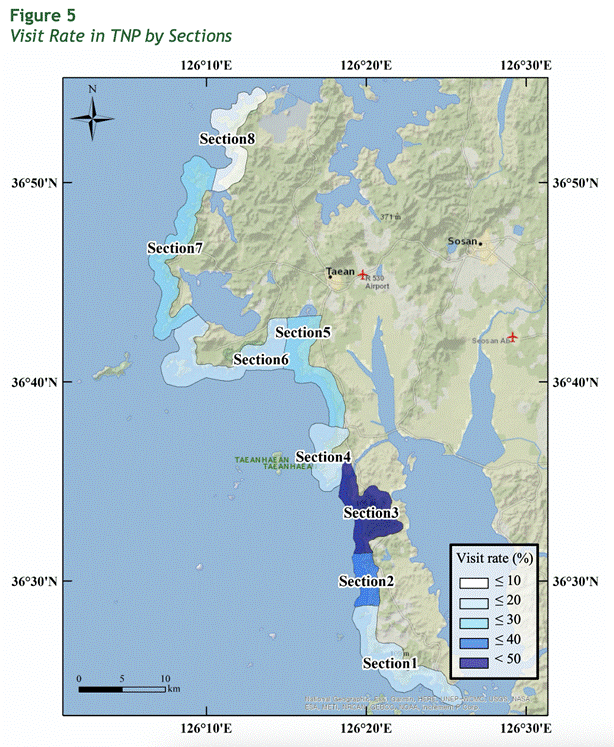
摘要:理解游客的移动模式对于实现可持续目的地管理目标至关重要,这有助于应对旅游业带来的环境、社会及文化影响。本研究从纵向视角出发,采用目的地测量方法,对泰安海岸国家公园内游客的移动模式进行了分析。通过移动定位数据获取了游客活动的空间分布与移动轨迹,并运用综合考虑地理、时间和构成维度的旅游目的地理论框架进行分析。结合该目的地的属性特征与生态保护价值,MPD分析被证明能够有效辅助公园管理者优化资源配置,并明确公园与游憩设施的定位特性。该分析通过获取更长期、一致性更高、分辨率更优的实时时空数据,并提升研究人群的代表性,拓展了对大型海洋国家公园游客行为模式的认知。研究结果将有助于公园管理者实施以调控特定环境中游客移动空间分布为核心目的的地管理规划。
Abstract: Understanding visitors’ movements is crucial to achieving the goals of sustainable destination management while dealing with the environmental, social, and cultural impact of tourism. This study examines the movement patterns of visitors within Taeanhaean National Park (TNP) by adopting a destination measurement approach from a longitudinal perspective. The spatial distribution of the visitors’ activities and movement patterns was obtained by using mobile positioning data (MPD) and we applied the theoretical concept of tourism destinations, which considers geographical, temporal, and compositional dimensions. Given the destination attributes and conservation values, the MPD analysis proved suitable as an aid for park managers to allocate resources efficiently and define the characteristics of park and recreation facilities. This analysis has extended our knowledge of visitors’ patterns at a large marine national park by increasing consistency and high resolution of real-time spatio-temporal data for longer periods and better representing the study population. The study results will allow park managers to implement destination management planning focused on influencing spatial distributions of visitors’ movements in a specific environment.
Choe, Y., Lee, W., & Lin, B. (2025). Exploring relationships among cultural ecosystem service values, spiritual well-being, and life satisfaction: Implications for the post-pandemic era. Tourism Analysis, 30(17), 45-61. https://doi.org/10.3727/108354224X17059673670361
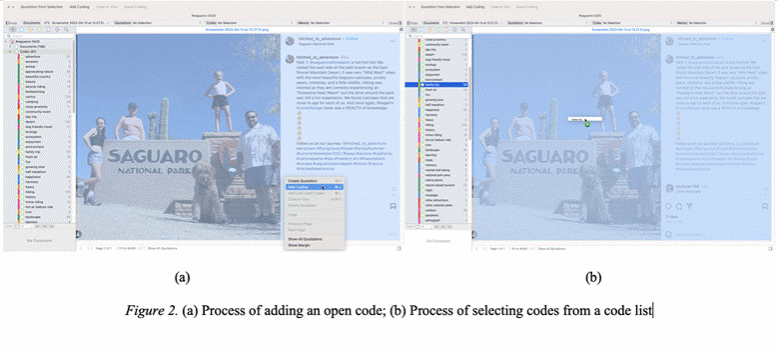
摘要: 文化生态系统服务在COVID-19时期对人类福祉产生了显著影响。本研究采用探索性混合方法,调查了游客在美国萨瓜罗国家公园感知的文化生态系统服务价值,并探究了这些价值在后疫情时代如何影响游客的精神健康与生活满意度。在定性研究阶段,通过对Instagram数据进行网络志分析,提炼出七个主题:国家环境、学习、社交、逃离与独处、心理健康、COVID-19期间的户外游憩以及COVID-19期间的旅游。随后,基于这些主题构建研究假设,并通过在线调查收集了316名参与者的数据,运用偏最小二乘结构方程模型对假设进行检验。结果表明,文化生态系统服务价值能显著影响精神健康的不同维度。本研究强调了个体精神健康与社群精神健康在文化生态系统服务价值与生活满意度之间的中介作用。此外,研究将实时社交媒体监测与文本图像的内容分析、以及定性结果的定量验证相结合,实现了方法的衔接。其管理启示为在后疫情时代推广中小型国家公园提供了建议。
Abstract: Cultural ecosystem services significantly affected human well-being in the COVID-19 era. This study investigates visitors’ cultural ecosystem service values at Saguaro National Park (US) and how those values affect tourists’ spiritual well-being and life satisfaction in the postpandemic era with an exploratory mixed-methods approach. In a qualitative phase using a netnographic analysis of Instagram data (N = 449), seven themes emerged: national environment, learning, socialization, escape and solitude, mental well-being, outdoor recreation during COVID-19, and tourism during COVID-19. Subsequently, these themes were used to develop and test the proposed hypotheses on data collected from 316 participants of an online survey using partial least squares structural equation modeling. The results disclosed that cultural ecosystem service values can significantly affect different dimensions of spiritual well-being. This study emphasizes the mediating role of personal and communal spiritual well-being between cultural ecosystem service values and life satisfaction. Further, it bridges the application of real-time social media surveillance with a content analysis of text and images and a quantitative analysis of qualitative results. The managerial implications provide suggestions for promoting small/medium national parks in the postpandemic era.