卢俊宇博士是亚利桑那州立大学社区资源与发展学院的助理教授,任职于海南大学亚利桑那州立大学国际学院。他的研究兴趣主要集中在气候变化与适应、农业社区参与、灾害与风险管理、公园及保护地等领域。他在研究中融合了多种先进方法,包括高级统计模型、GIS技术、高性能计算和云计算。他已发表超过45篇同行评审期刊文章,其中包括以第一作者身份在 Nature Sustainability, Scientific Reports, Journal of Environmental Management, Agricultural and Forest Meteorology, Applied Geography, Cities, Current Issues in Tourism, Tourism Management Perspectives 等顶级期刊上发表的文章。他曾担任期刊 Society and Natural Resources 的编委。
在加入亚利桑那州立大学之前,他在普渡大学自然资源社会科学实验室从事博士后研究。他参与了多个研究项目,致力于理解由"有用到可用"团队开发的在线农业决策支持工具的使用情况,并调查影响农业保护措施采纳的因素。他于2018年在南卡罗来纳大学哥伦比亚分校获得地理学博士学位和应用统计学硕士学位。在读博期间,他曾在美国国家海洋和大气管理局的"卡罗来纳综合科学与评估"团队工作了五年,参与了一系列气候变化和极端天气研究项目。
Dr. Junyu Lu is an assistant professor in the School of Community Resources and Development at Arizona State University and located at HNU-ASU International College, Hainan University. His research interests are mainly in the area of climate change and adaptation, agricultural community engagement, disaster and risk management, and parks & protected areas. He integrates advanced methodologies into his research areas, including advanced statistical models, GIS techniques, high-performance computing (HPC), and cloud computing. He has published more than 45 peer-reviewed journal articles, including first-authored publications in top-tier journals such as Nature Sustainability, Scientific Reports, Journal of Environmental Management, Agricultural and Forest Meteorology, Applied Geography, Cities, Current Issues in Tourism, Tourism Management Perspectives, etc. He served as the editorial board member of the journal Society and Natural Resources.
Before joining ASU, he was a postdoc in the Natural Resources Social Science Lab at Purdue University. He participated in multiple research projects on understanding the use of online agricultural Decision Support Tools developed by the Useful to Usable (U2U) team and investigating factors influencing the adoption of agricultural conservation practices. He completed a Ph.D. degree in Geography and a Master’s degree in Applied Statistics from the University of South Carolina – Columbia in 2018. During his Ph.D. period, he worked with NOAA’s Carolinas Integrated Sciences and Assessments (CISA) team for five years on a range of climate change and extreme weather research projects.
谷歌学术网址Google Scholar link: https://scholar.google.com/citations?user=eMQ5SP0AAAAJ
亚利桑那州立大学个人网页ASU webpage: https://search.asu.edu/profile/2109652
部分发表成果Selective Publications
1. Lu, J., Lemos, M. C., Koundinya, V., & Prokopy, L. S. (2022). Scaling up co-produced climate-driven decision support tools for agriculture. Nature Sustainability, 5(3), 254-262. https://doi.org/10.1038/s41893-021-00825-0
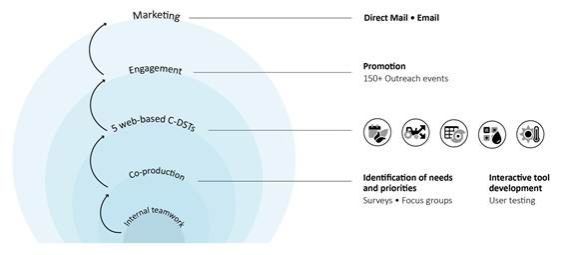
人们日益相信,学术界与非学术界之间共同生产知识对于解决可持续性问题至关重要。然而,对于知识共同生产之后会发生什么,以及共同生产的知识能否以及如何扩大规模,人们知之甚少。本文聚焦于由美国中西部的研究人员、农民和农业顾问共同开发的气候驱动型农业决策支持工具。通过对农民和农业顾问的两项调查(N=5,393),文章考察了旨在推广这些工具的用户互动参与活动和营销活动如何影响其使用。研究发现,除了高度迭代的共同生产过程之外,其他形式的用户互动,如推广参与和营销活动,对于扩大共同生产知识的影响力也至关重要。一个积极的发现是,大多数未参与互动阶段的受访农民和顾问表示,共同开发的工具满足了他们的需求,并且正在使用、考虑使用或愿意推荐这些气候驱动型决策支持工具。因此,虽然仅有共同生产并不能保证知识的传播,但它确实提高了知识的适用性和使用率。然而,要实现大规模使用的传播,可能需要研究者和资助方做出持续的努力,在共同生产之后进行推广并评估使用情况,以更好地理解其社会影响,以及共同生产的知识在解决可持续性问题中的作用。
There is growing belief that the co-production of knowledge between academics and non-academics is critical to address sustainability problems. Yet, little is known about what happens after co-production and whether and how co-produced knowledge scales up. This article focuses on climate-driven decision support tools co-produced by researchers, farmers and agricultural advisers in the US Midwest. Through two surveys (N = 5,393) with farmers and agricultural advisers, it examines how engagement and marketing campaigns to disseminate the tools influenced their use. Here we find that beyond the highly iterative co-production process, other forms of user interaction such as outreach engagement and marketing campaigns are critical to scale up the impact of co-produced knowledge. Positively, we also show that most surveyed farmers and advisers who were not involved in the engagement phase reported having their needs met by the co-produced tools and were using, considering using or willing to recommend the climate-driven decision support tools. Hence, while co-production alone does not guarantee dissemination, it does increase knowledge fit and use. Dissemination for mass use, however, might require a committed effort from researchers and funders to promote and evaluate use post co-production to better understand societal impact and the role of co-produced knowledge in addressing sustainability problems.
2. Lu, J., Xiao, X., Huang, X., Chuai, X., Li, Z., Wei, H., & Wang, S. (2024). Big data insights into urban park use in the pandemic: Changes in visitation patterns and exacerbated social inequalities in the U.S. Cities, 152, 105204. https://doi.org/10.1016/j.cities.2024.105204
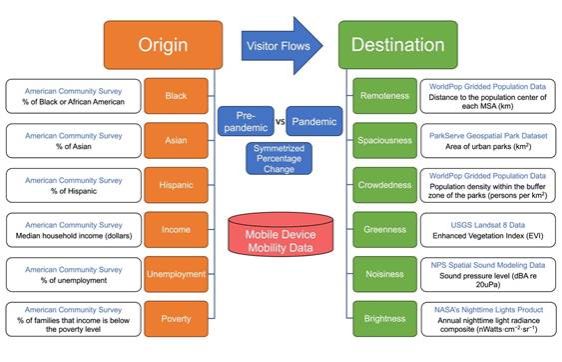
城市公园对于维护健康、宜居和可持续的城市至关重要。确保城市公园平等地服务于所有社区,特别是在疫情期间以及对于传统弱势群体而言,尤为重要。本研究探讨了新冠疫情如何改变了城市居民访问城市公园的模式,并评估了疫情是否加剧了美国不同社会人口群体在获取城市公园资源方面的不平等。我们从来源地和目的地两个方面调查了城市居民的访问模式,并采用了大数据方法,整合了移动设备的位置移动数据、遥感/地理空间数据、社会经济数据等。研究发现,与大流行前(即2019年)相比,疫情期间(即2020年和2021年)城市居民更倾向于访问那些更偏远、面积更大、绿化更好、人群更不密集、噪音更少且人类活动较少的城市公园。我们的结果还突出表明,疫情加剧了城市公园获取方面的社会不平等。来自种族/族裔少数群体比例更高、失业率和贫困率更高、收入更低的街区群体的城市居民,受到疫情的负面影响更大,去城市公园的可能性更低。更重要的是,与2020年疫情初期相比,这种社会不平等在2021年进一步加剧。
Urban parks are essential to maintaining healthy, livable, and sustainable cities. It is vital to ensure urban parks serve the communities equally, particularly during the pandemic and for traditionally disadvantaged groups. This study examined how the COVID-19 pandemic changed urban dwellers' visitation patterns to urban parks and assessed whether the pandemic exacerbated the inequalities of urban park access among different sociodemographic groups in the U.S. We investigated urban dwellers' visitation patterns from two aspects (origin and destination) and used a big data approach by integrating mobility data from mobile devices, remote sensing/geospatial data, socioeconomic data, etc. This study found urban dwellers preferred visiting urban parks that were remoter, larger, greener, less crowded, less noisy, and with less human activities during the pandemic (i.e., 2020 and 2021) vs. pre-pandemic (i.e., 2019). Our results also highlighted that the pandemic exacerbated social inequalities in urban park access. The urban dwellers from block groups with higher percentages of racial/ethnic minorities, higher unemployment and poverty rates, and lower income were more negatively influenced by the pandemic and became less likely to visit urban parks. More importantly, such social inequalities further increased in 2021 compared with the early pandemic period of 2020.
3. Lu, J., Ranjan, P., Floress, K., Arbuckle, J. G., Church, S. P., Eanes, F. R., Gao, Y., Gramig, B. M., Singh, A. S., & Prokopy, L. S. (2022). A meta-analysis of agricultural conservation intentions, behaviors, and practices: Insights from 35 years of quantitative literature in the United States. Journal of Environmental Management, 323, 116240. https://doi.org/10.1016/j.jenvman.2022.116240
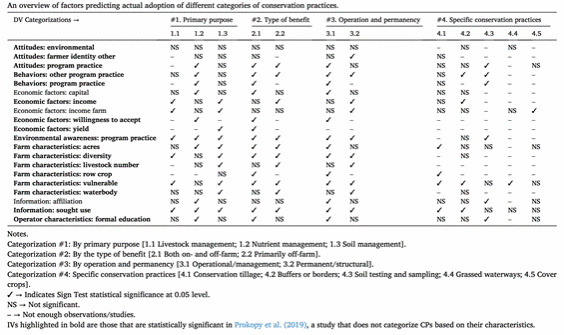
保护性实践对于维持农业生态系统长期生存能力至关重要。由于耕作系统以及农民的价值观和态度具有异质性,能够一致预测保护行为的因素仍然难以确定。此外,不同研究在所考察的保护性实践类型、以及测量的是行为意愿还是实际行为方面也存在异质性。本研究考虑了每种保护性实践的特性,以及特定研究测量的是行为意愿还是实际行为,以期更好地理解农民对保护性实践的采纳。我们回顾并分析了美国35年间(1982-2017年)的定量保护采纳文献。我们根据保护性实践的主要目的、提供的效益类型以及其属于操作性还是结构性实践进行了分类。我们还重点考察了以下五种实践:保护性耕作、缓冲区或边界、土壤测试、植草水道和覆盖作物。在我们的行为意愿和实际行为分析中,我们发现态度因素能同时预测保护意愿和行动(实际行为),而当前或既往的实践使用仅影响行动,不影响陈述的保护意愿。在我们关注保护性实践特性的分析中,我们发现,对特定保护性实践的具体了解和积极态度、采纳其他保护性实践、寻求和使用信息、更大的农场规模以及土地易受损害的特性,几乎在所有保护性实践分类中都能预测实际采纳情况。比较具有特定共同特性的保护性实践的预测因素时,会出现一些细微差别。例如,我们发现农场特征在预测土壤管理类保护性实践的采纳方面比养分和牲畜管理类实践更为重要,而农民的管家身份认同对永久性实践的重要性高于操作性实践。
Conservation practices (CPs) are integral to maintaining the long-term viability of agro-ecological systems. Because farming systems and farmers' values and attitudes are heterogeneous, factors that consistently predict conservation behaviors remain elusive. Moreover, heterogeneity is present among studies regarding the type of CPs examined, and whether behavioral intentions or actual behaviors were measured. This study considers the characteristics of each CP, and whether a given study measured behavioral intention or actual behavior, to better understand farmers' adoption of CPs. We reviewed and analyzed 35 years (1982-2017) of quantitative conservation adoption literature in the United States. We categorized CPs based on their primary purpose, the type of benefit they provide, and whether they are operational or structural. We also examined the following five CPs: conservation tillage, buffers or borders, soil testing, grassed waterways, and cover crops. In our behavioral intention and actual behavior analysis, we found that attitudinal factors predicted both conservation intention and action (actual behavior), whereas current or previous use of practices only influenced actions, not stated conservation intentions. In our analysis focusing on CP characteristics, we found that having specific knowledge about and positive attitudes toward the CP, adoption of other CPs, seeking and using information, larger farm size, and vulnerable land predicted actual adoption across nearly all CP categorizations. Nuances emerge when comparing predictors of CPs that share a particular characteristic. For example, we found farm characteristics to be comparatively more important in predicting adoption of soil management CPs than nutrient and livestock management CPs, and farmers' stewardship identity to be more important for permanent practices than operational practices.
4. Lu, J., Carbone, G. J., & Grego, J. M. (2019). Uncertainty and hotspots in 21st century projections of agricultural drought from CMIP5 models. Scientific Reports, 9(1), 4922. https://doi.org/10.1038/s41598-019-41196-z
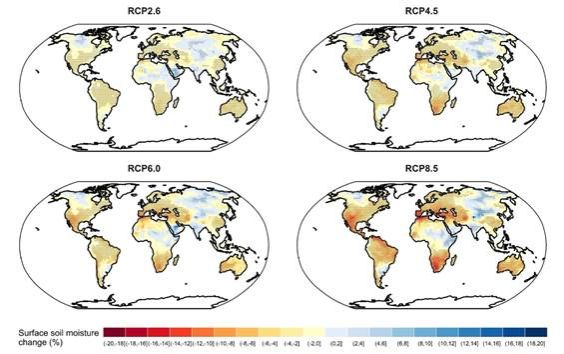
未来气候变化可能改变水文气象模式,并改变全球到区域尺度的干旱性质。然而,未来干旱预测存在相当大的不确定性。本文通过分析CMIP5多模型集合在RCP2.6、RCP4.5、RCP6.0和RCP8.5情景下的表层土壤湿度输出,重点关注农业干旱。首先,到21世纪末,所有情景下的年平均土壤湿度均显示出统计上显著的大范围干旱以及有限的湿润区域,且随着辐射强迫增强,干旱程度加剧。其次,预测显示,在所有区域和所有未来RCP情景下,严重干旱的MME平均空间范围都将扩大,尤其是在中美洲、欧洲及地中海地区、热带南美洲和南非。第三,在内部变率、模型不确定性和情景不确定性这三个不确定性来源中,模型不确定性在整个21世纪是最大的不确定性来源(超过80%)。最后,我们发现,土壤湿度异常的年和季节信噪比的空间格局和量级不随超前时间而发生显著变化,这表明不确定性的范围随着信号的增强而变大。
Future climate changes could alter hydrometeorological patterns and change the nature of droughts at global to regional scales. However, there are considerable uncertainties in future drought projections. Here, we focus on agricultural drought by analyzing surface soil moisture outputs from CMIP5 multi-model ensembles (MMEs) under RCP2.6, RCP4.5, RCP6.0, and RCP8.5 scenarios. First, the annual mean soil moisture by the end of the 21st century shows statistically significant large-scale drying and limited areas of wetting for all scenarios, with stronger drying as the strength of radiative forcing increases. Second, the MME mean spatial extent of severe drought is projected to increase for all regions and all future RCP scenarios, and most notably in Central America (CAM), Europe and Mediterranean (EUM), Tropical South America (TSA), and South Africa (SAF). Third, the model uncertainty presents the largest source of uncertainty (over 80%) across the entire 21st century among the three sources of uncertainty: internal variability, model uncertainty, and scenario uncertainty. Finally, we find that the spatial pattern and magnitude of annual and seasonal signal to noise (S/N) in soil moisture anomalies do not change significantly by lead time, indicating that the spreads of uncertainties become larger as the signals become stronger.